Treasures 250
In honor of the American Semi quincentennial, the NSCDA’s Treasures 250 initiative highlights 250 of the most remarkable objects found at the 95+ Great American Treasures sites across the nation. Many of these sites hold collections that showcase both their own history and the dedication of those who have ensured their preservation. Through our Great American Treasures partners, the NSCDA seeks to show the breath of American history through objects commemorating both everyday moments and historical occasions in our nation’s 250 years.
This project reminds us of the power of objects to tell the story of the United States and the communities that have shaped it. While disparate in origin and purpose, together this collection tells America’s story.
-
Alabama
Map of Gulf Coast
Conde-Charlotte Museum, Mobile, AL
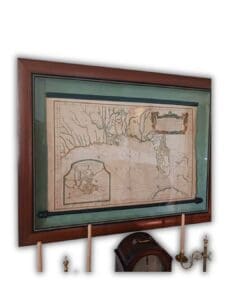
Map of the Louisiana and Florida coasts by French hydrographer S. Bellin. Hand colored. “Carte Reduite des Costes del la Louisiane et de la Floride” Placed on rollers in 1961.
Silver Four Piece Tea and Coffee Service by Simon Chaudron
Conde-Charlotte Museum, Mobile, AL
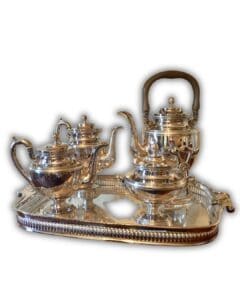
Silver. Coffee pot, teapot, covered sugar dish, and teakettle on stand. Marked “Chaudron’s & Rash” Simon Chaudron was a French refugee who fled Haiti in 1793 for Philadelphia, Pennsylvania. He was a watchmaker, silversmith, goldsmith, wine importer, orator, author, and poet. His most famous writing was his “Funeral Oration on Brother George Washington” eulogy to the first U.S. President and fellow Masonic brother. In 1817 He and his family settled in the Demopolis Vine and Olive Colony until he moved to Mobile in the early 1820’s.
Lead Knuckles
Conde-Charlotte Museum, Mobile, AL
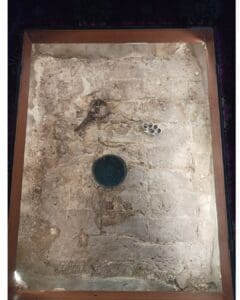
These crude handmade lead knuckles were found during the 1947 restoration of the Conde-Charlotte Museum House conducted by Nick Holms. The wood flooring of the first floor was removed to reveal the two-foot-thick flooring of the original jail. Outlines of the original jail cells were visible, and a foreman noticed a loose brick that hid these knuckles underneath. It is believed that a prisoner managed to sneak them into his cell, scrape away at the mortar to loosen the brick and hid them underneath.
Kirkbride Portraits
Conde-Charlotte Museum, Mobile, AL
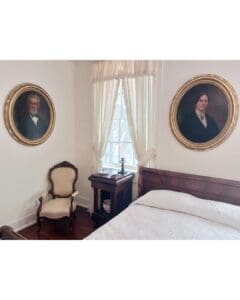
Oval frame, Oil 35 X30. Portraits of Johnathan Kirkbride (1818-1895) and his wife Elizabeth Bassett (1823-1872). Johnathan Kirkbride was a master builder and a contractor. Johnathan Kirkbride purchased the then abandoned jail in 1849 and converted it into his residence that would one day become the Conde-Charlotte Museum. These portraits were donated by the Kirkbride’s great granddaughter Mrs. Sydney Prince, Jr.
Wedding (?) Dress
Conde-Charlotte Museum, Mobile, AL
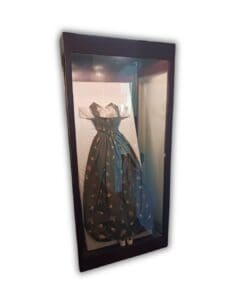
Worn by Wills Nobbs Hall (1759-1821) wife of Dr. Robert Hall, surgeon Third Regiment, North Carolina Continental Army. The dress has been carbon dated by the Smithsonian institute and has been examined by three textile conservators. The shoes are hand sewn soft leather with heavier leather soles. This dress was given to the Conde-Charlotte Museum House by Mrs. Benjamin Meek Miller Childers, Mrs. Hall’s great, great, great, granddaughter in memory of her mother, Mrs. Robert T. Jones and her Aunt, Mrs. Ralph Nicolson.
-
Arkansas
Secession Quilt
Brownlee Noland House
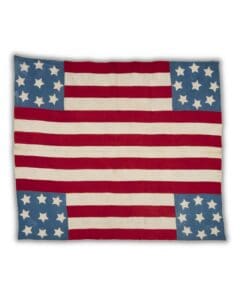
During the Civil War, patriotic women on both sides of the conflict took up their sewing needles and quilted to raise funds for ill-equipped soldiers. On many occasions during the war, quilts were used as graphic political statements, and some were considered dangerous enough to suppress or destroy. Mary McPherson of West Point, Arkansas, made her quilt to raise funds at a local raffle for Confederate soldiers in need. Far from a humble bed covering, the masterpiece she created was also a political statement, as her nine trapunto stars symbolize Arkansas as the ninth state to secede from the Union. When word got out about McPherson’s “rebel quilt,” Union soldiers put her under house arrest until the war’s end. In later newspaper accounts, it was said that McPherson’s quilt stayed hidden as it passed from plantation to plantation, and attic to cellar.
Arkansas Traveller Lithograph
Brownlee Noland House
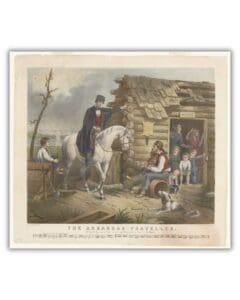
Much has been written about the history of the Arkansas Traveler story, which was known in the mid-nineteenth century as a popular tune, a humorous dialogue, a painting, and a print. First immortalized in paint by Arkansas artist Edward Payson Washbourne in 1856, then faithfully copied as a hand-colored lithograph by Leopold Grozelier of Boston in 1859, the image was reproduced in hundreds of different forms thereafter. The Arkansas Traveler folk tale was made famous in the 1840s by Sandford “Sandy” Faulkner, a prominent plantation owner, banker, and politician. The generally accepted backstory puts Faulkner lost in the rural Boston Mountains with a group of friends and political allies including some combination of Ambrose Sevier, William S. Fulton, Archibald Yell, and Chester Ashley. However, whether this famous yarn is based on a real encounter is mostly irrelevant, since for storytellers and performers like Sandy Faulkner, much of the fun derived from recounting tall tales was in playing a practical joke that took advantage of gullible or naïve listeners.
Unfortunately, dialog between the Traveler and the Squatter was easily misinterpreted by outsiders who incorrectly assumed the rural Squatter must have been a simpleton. In humorous performances and national print media, the Arkansas Traveler came to represent a negative stereotype of Arkansans that persisted well into the 20th century. As Louise Loughborough, founder of Historic Arkansas Museum once said, “A leaky roof, a coonskin cap, a fiddle and jug were not the outstanding characteristics of early Arkansas.”
Bowie Knife
Brownlee Noland House
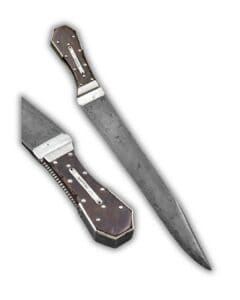
In the decades following the Louisiana Purchase of 1803, violence and corruption plagued westward migration. Settlers traveled well-armed, prepared to defend themselves against a host of real and perceived threats. Within months of the infamous 1827 Sandbar Fight, Jim Bowie and his prowess with a blade attracted national attention. Soon, almost everyone wanted a knife “like Bowie’s” or “a Bowie knife.”
This massive guardless-coffin knife is known among knifemakers and collectors as one of the most intriguing Bowie knives in existence. Its physical characteristics—the coffin shape and silver wrap of the handle, silver escutcheon plates and pins, rich burl-wood scales, and a tapered full tang—closely match other knives attributed to James Black’s shop. Several reliable accounts claim that fighter and fortune-seeker Jim Bowie purchased a custom knife from James Black, and some historians suggest that Black’s Bowie No. 1 could be that legendary blade. But peculation abounds, and this historical puzzle continues to confound both amateur and professional knife sleuths.
Mourning Sampler
Brownlee Noland House
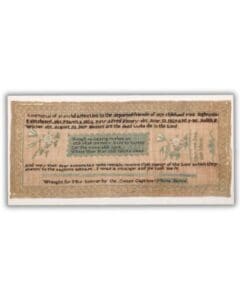
This memorial sampler made by Maria James, a young woman known as the Osage Captive, is one of the most significant needlework samplers in the museum’s collection. In the early 1800s, after their removal to Indian Territory, Osages and Cherokees waged war against each other. During that time, a four-year-old Osage girl was taken captive and adopted by Blackcoat, a chief of the Cherokees. One day, a white man persuaded Blackcoat that he could give the girl many advantages because he had no children of his own. Unfortunately, the white man soon sold the girl to another who hoped to make a profit by selling her into slavery. In a lucky reversal of fortune, a group of French boatmen discovered the little girl and organized a posse to recover her and arrest her captor. The girl was rescued and taken to the Dwight Mission in Indian Territory, where she was given the name Maria James. Maria grew up to become a beloved teacher, and she married a Cherokee man named William Petit. During her time at the Dwight Mission, Maria stitched this delicate memorial sampler, dedicated to the missionaries who cared for her after her abduction.
The sampler reads: A memorial of grateful affection to the departed friends of my childhood Mrs. Sophronia/ S. Hitchcock, obt. March 2, 1826. Rev Alfred Finney obt. June 13, 1829 And Mrs. Judith F./ Wisner. obt. August 22, 1829.
Blessed are the dead who die in the Lord. Through rejoicing in their lot/ Still shall memory love to weep/ Oer the venerable spot/ Where their dear [cold] relicks sleep/ They rest from their labours. And may their dear associates who remain receive that mercy of the Lord which they/ shewd to the captive outcast. I was a stranger and ye took me in/ Wrought for Mrs. Sumner by the Osage Captive. Maria James.
Brownlee House
Brownlee Noland House
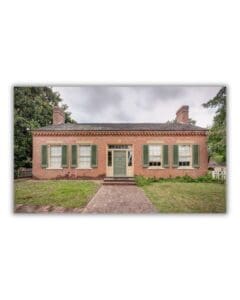
The houses on Block 32 (the land that eventually became Historic Arkansas Museum) were originally part of the oldest neighborhood in the city; the riverfront and Markham Street to the north of the Block attracted a small community of settlers as early as 1821.
By 1837, Scottish stonemason Robert Brownlee (1813-1897) moved to Little Rock to help build the State House (now the Old State House Museum), which served as Arkansas’s original capitol building until 1911. In 1842, Robert’s brother James, a blacksmith, and Isabelle, his sister-in-law, arrived from Scotland. Around four years later, Robert Brownlee built this Georgian vernacular brick cottage. Although Robert retained ownership of the property, James Brownlee and his wife Isabelle lived there with two enslaved individuals until at least 1852. James and Isabelle eventually returned to Scotland, and the Brownlee house was sold to Dr. Roderick L. Dodge.
Robert Brownlee’s advertisement for the sale of the Brownlee house, published in the Arkansas Gazette, April 12, 1850:
1-story brick dwelling house on… Cumberland between Cherry and Mulberry Streets…. [The] house contains 2 neatly furnished rooms, separated by a spacious and airy hall. On the premises are a kitchen, smokehouse with cellar and other outbuildings, together with a well.
-
California
Sideboard
La Casa de Machado y Silvas, San Diego, CA
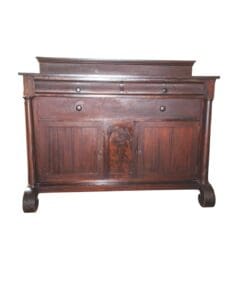
Buffet (sideboard dining room dresser) with two small silverware drawers at the top, one large drawer in the middle, and two drawers (full width halved) at the bottom. Finished in dark mahogany stain.
French workmanship. Original catalog card states: “This piece is of the French Empire style. The Empire period was from 1804 to 1815. The motif is predominantly heavy and massive, suggesting grandeur, and evoking a sense of power and authority through the medium of wood.”
Traveling Trunk
Octagon House, San Francisco, CA
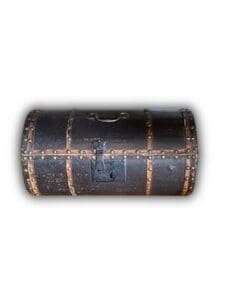
A traveling trunk with cylindrical wood frame covered in leather with leather straps set with brass studs, American, 18th century. Old fashioned “carry on.”
-
Colorado
Hot Sauce
Hotel de Paris, Georgetown, CO
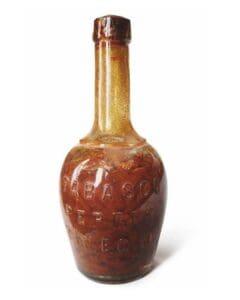
An unopened bottle of pepper sauce made of aged red peppers, distilled vinegar, and salt at the Tabasco factory on Avery Island, Louisiana is a rare culinary artifact. Because this condiment was only produced between 1868-1878, it represents one of the earliest items created by American businessman and manufacturer Edmund McIlhenny and preferred by Louis Dupuy, who was known as the Best Cook in the Colorado Territory.
Poker Chips
Hotel de Paris, Georgetown, CO
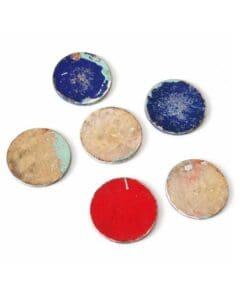
A small collection of handmade poker chips discovered in the former in-house laundry of Hotel de Paris suggests private gambling activities. The well-worn gaming tokens (representing a range in values) are being researched by staff at Hotel de Paris Museum to determine their origin and significance, as well as a possible connection to John Touk, a Chinese gardener and porter employed by proprietor Louis Dupuy in the 1880s.
Frederick Douglass Speeches
Hotel de Paris, Georgetown, CO
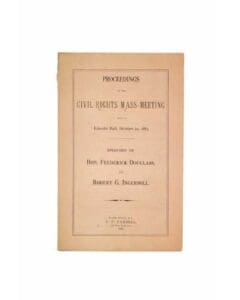
An 1883 copy of Frederick Douglass’ speeches was part of The Dupuy Library, a collection of printed materials assembled prior to 1900 by proprietor and social rebel Louis Dupuy. The publication addressed national responsibility in protecting the rights of its citizens, equality for formerly enslaved persons, and protests regarding the struggle for civil rights. Dupuy also owned a copy of James Freeman Clarke’s account of the American abolitionist movement.
Zinc Statues
Hotel de Paris, Georgetown, CO
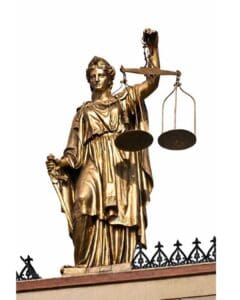
Although advertised and sold by J.L. Mott Iron Works of New York City through its illustrated catalogues, the ornamental cast figures Justice or Justice Unblinded, Reclining Stag, Lion (Schiffelmann), Boy Fountain, and Boy and Duck at Hotel de Paris were manufactured and supplied to Mott by M.J. Seelig & Company sometime in the 1890s. This Jewish owned metal foundry was considered the foremost producer of zinc statuary in the United States.
-
Connecticut
British Hand Flocked Wallpaper
Webb Deane Stevens Museum, Wethersfield, CT
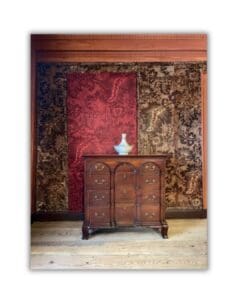
A complete run of in situ British hand flocked wool wallpaper. The paper came through an American port in 1765 as is evidenced by the tax stamp on the reverse of paper. The paper represented the height of English fashion. Flocked papers were a more economical alternative to excessively priced silk and wool damask wallcoverings popularized in the palaces of European aristocracy. The more economical papers provided an entry into aristocratic fashion for the gentry and merchant class of Britain and the empire. The paper was installed during the residency of Silas Deane (1738 – 1789) when he was married to Mehitable Nott Webb (1732 – 1767). The paper has been continuously maintained since first installed largely because of the tradition passed down that the chamber it decorates was the one in which George Washington stayed in May of 1781. The significance of this paper and occupancy was so prized that when the door to the room was moved over several feet in 1820 the section of wall cut out with the paper was maintained and remains in the museum collection. In its original form, the paper has a painted background of a rose colored red with a floral pattern printed in a hide glue and darker wine colored wool fibers adhered to the glue through a static process. It is believed that the pattern is derived from a silk pattern created by noted 18th century cartoonist Anna Maria Garthwaite (1688 – 1763).
Laura Mitchell Schoolgirl Sample
Webb Deane Stevens Museum, Wethersfield, CT
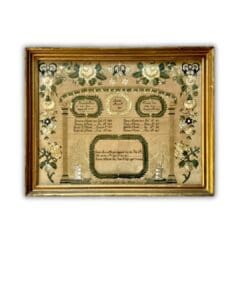
This schoolgirl sampler was made about 1830 by Laura Michell (1817 – 1834) possibly at Miss Ann Cornwall’s School in Glastonbury, CT. The needlework is indicative of the type and school associated with girls education in Connecticut during the early Republic. It is constructed of silk and wool stitching on a linen backing. Laura Michell was a member of a prominent Glastonbury family who pushed for women’s education and the abolition of slavery in early 19th century Connecticut. Her paternal cousins, the Smith family of Glastonbury, produced two generations of female educators and suffragists. Michell herself died at the age of 17 raising the question of what her future would have been had she lived. The sampler is a tangible testament to early advocacy for women’s education in Connecticut.
-
Florida
Handwoven Coverlet
Ximenez Fatio House, St. Augustine, FL
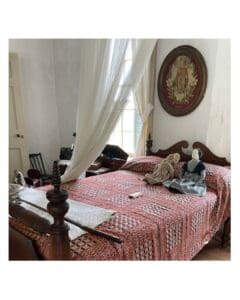
Hand woven coverlet, natural red and blue wool on linen warp.
W: 76″ x L: 80″, center seam, hole near seam at one end, some wear. Condition: Fair.
Acquired Dec. 8 1978, Date: c. 1880, purchased from Flewoochi Farms Antiques, Barnesville, GA.
Displayed on double bed in second floor Family Room.
Handwoven Coverlet
Ximenez Fatio House, St. Augustine, FL
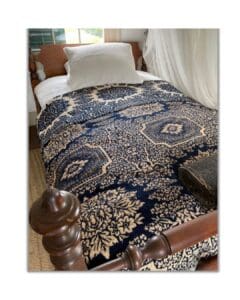
Indigo and blue and white double weave Jacquard wool and cotton coverlet, double bed size, fringes intact, floral pattern. Double weave or double cloths coverlets were woven on handlooms as well as partial or full mechanized looms. They have two sets of warps and two sets of wefts, simultaneously producing two separate layers of cloth that are interwoven at predetermined intervals. The layers of cloth can actually be pulled apart. The pattern on one side is repeated on the reverse side, usually in a lighter color.
L : 70″ x W: 66″ Condition: Good.
Acquired as a purchase by Mrs. W. G. Lockwood and Mrs. John H. Rogers, July 20, 1985. Date: c.1840.
Displayed in second floor Artists/Writers Room.
-
Georgia
Breakfront secretary bookcase
Andrew Low House, Savannah, GA
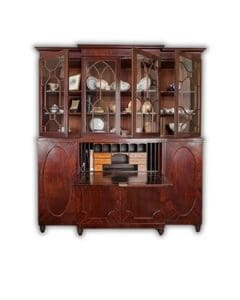
This breakfront mahogany secretary bookcase has a flat cornice with moldings above four bookcase sections, each with glass doors with mahogany mullions. The lower case has a centered fall-front secretary drawer. The center section is flanked by cupboards. The panels on the lower case are constructed of very finely figured plum-pudding mahogany veneered on mahogany with rosewood banded edges. The Joseph B. Barry & Son label is glued on the bottom of the drawer at the lower, proper left side of the interior. The lower case is set on a platform which is raised on six beehive-turned feet.
This secretary bookcase represents an exceptional example of American craftsmanship at its highest level. With few signed or labeled works by Barry known to survive, this piece stands out for its remarkable sophistication and masterful execution. In 1798 Robert Mackay moved to Savannah briefly and rented retail space from Robert Mackay of Meins & Mackay, an importing company. Having made
Barry’s acquaintance, Mackay probably acquired this secretary from him soon after his Savannah venture. It has remained with the Mackay family descendants ever since.
This remarkable secretary bookcase serves as a centerpiece of the back parlor at the Andrew Low House, gracefully filled with books, fine china, and decorative objects. Its open desk reveals copies of Andrew Low’s letters, offering a glimpse into the family’s daily life during the 1830s. More than just a piece of furniture, it reflects the refinement and aspirations of a privileged household, capturing the elegance and expectations of their time. As such, it holds a special place in our collection, connecting today’s visitors to the lived experience of the Low family.
Bronze Statue
Andrew Low House, Savannah, GA
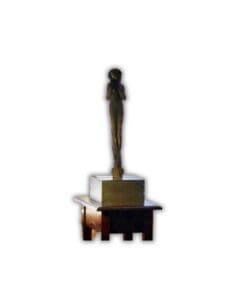
The “Lady of the Fountain” is a bronze statue of a water nymph designed by Juliette Gordon Low in circa 1923-1926. The bronze was cast from clay sculpted by Juliette. It was originally part of a fountain in a private park in Gordonston, a small suburb southeast of downtown Savannah. The statue was moved to the Andrew Low House Museum Garden, and in 2015 was conserved and moved into the house for display. This small elegant woman is depicted with long hair and is draped in a diaphanous dress. Her hands are raised to her face in a subtle, slightly protective gesture. This work is of particular significance within our collection as it is an original creation by Juliette Gordon Low. It exemplifies her artistic training and skill, while also conveying her refined sensitivity to feminine subjects. It now sits in the Low Bedroom which was once her art studio.
Portrait of Mary Cowper Stiles
Andrew Low House, Savannah, GA
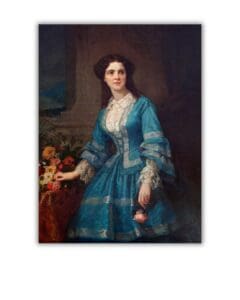
The portrait of Mary Cowper Stiles was done in Paris on her honeymoon with Andrew in 1854. She wrote to her mother stating that she wore a “simple blue day dress.” She stands posed in front of a classical backdrop next to a bouquet of flowers and holds a single peony in her left hand. She gazes off to the right with the slightest of smiles on her face; her hair is modestly pulled up in front and hangs loose in back. Her dress has a collared blouse-like underlay at the neck with a lace front. Blue taffeta makes up the embroidered jacket and skirt. Two tiers of large ruffles fall from each sleeve and cover a longer lace sleeve underneath.
The portrait of Mary is a large oil on canvas, framed and located in the parlor of the Andrew Low House. Mary was the second wife of Andrew Low and would have been Juliette’s mother-in-law. Mary was a spirited young woman and was said to have been both a better rider and shot than her brothers. Beautiful andcharming, Mary’s short life came to an end at the age of thirty, likely during childbirth.
This portrait holds particular significance within our collection due to the remarkable story of its arrival. It was first noticed by a gentleman researching his family lineage, who alerted the museum’s director to its inclusion in an upcoming auction. The painting had been placed in an English gallery by descendants seeking to settle an estate. Acting swiftly, the Georgia Dames rallied resources to secure the work, successfully acquiring it for the museum in November of 2013.
Mourning Jewelry Set
Brown Stetson Sanford House, Milledgeville, GA
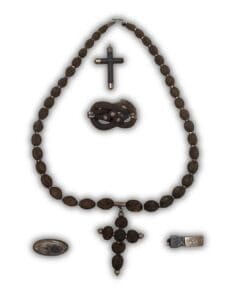
This remarkable mourning jewelry set is woven entirely from the hair of a deceased loved one. The set includes a necklace with a cross pendant and remains in exceptional condition despite its age. Each bead was painstakingly woven by hand. Although the original owner and exact date of creation are unknown, the set reflects the tradition of mourning jewelry, which allowed families to memorialize loved ones through wearable keepsakes. As both a work of craftsmanship and an expression of personal grief, the jewelry provides a rare glimpse into nineteenth-century attitudes toward remembrance and loss.
Business Ledger
Brown Stetson Sanford House, Milledgeville, GA
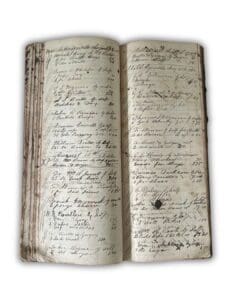
This handwritten ledger documents the business activities of Daniel Stetson, whose family transformed the former Brown Hotel into a private residence that later became the Brown-Stetson-Sanford House museum. The volume contains entries spanning several decades, beginning in Augusta and continuing through Stetson’s relocation to the state capital, with records extending to 1861. The ledger provides an extraordinary first-hand account of affairs in antebellum Georgia. Through its pages, one can trace Stetson’s movements, business dealings, and connections across the state during a period of significant economic and political change.
Crazy Quilt
Brown Stetson Sanford House, Milledgeville, GA
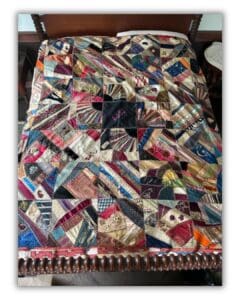
This elaborate crazy quilt, dated 1883, exemplifies one of the most popular forms of decorative needlework in late nineteenth-century America. Constructed from irregularly shaped fabric pieces arranged in a seemingly random pattern, the quilt showcases the creativity and technical skill associated with the Victorian crazy quilt movement. While the maker remains unknown, the quilt survives as an important example of domestic artistry and textile preservation during the Gilded Age.
Dollhouse
Brown Stetson Sanford House, Milledgeville, GA
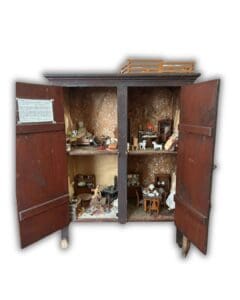
This doll house and its contents were created over the span of ninety years (1897-1987). The items in this dollhouse belonged to Katherine K. Scott (1894-1988) of Milledgeville. The doll house dates from 1897 and was made by soldiers at Ft. McPhereson for Miss Katherine Scott while her family lived there during the time her father, MAJ Albert B. Scott was acting commandant of the fort.
-
Illinois
Frances Macbeth Glessner Salt Cellars
Glessner House, Chicago, IL
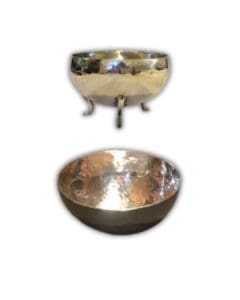
Frances Macbeth Glessner (1848-1932) had her first lesson in silversmithing in November 1904. Originally studying under Madeline Yale Wynne, she soon engaged two additional teachers, Annibale Fogliata (from Hull-House) and Frederik W. Sandberg, as her interest in metalwork deepened. Over the next decade or so, she produced hundreds of pieces, almost all of which were presented as gifts to friends and family members.
The two salt cellars shown here, and displayed in the dining room, were early products of her craft. The bottom piece, which measures 2-7/8 inches in diameter, was presented to her husband as a Christmas gift in 1904, less than a month after launching her new pursuit. The top piece, measuring 2-1/4 inches in diameter, was a Christmas gift to her brother Charles Edgar Macbeth in 1905.
Both exhibit her trademark hammered finish, representing the process of hammering the sheet silver against wooden forms. The finish is typical of Arts & Crafts silver of the period and distinguished it from machine made pieces. They are unadorned, their beauty being derived from the graceful forms.
Cane
Glessner House, Chicago, IL
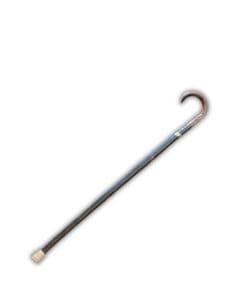
Among the more utilitarian objects at Glessner House is a plain wooden cane, which hangs on a hook in John Glessner’s dressing room. The cane is ebonized, except for the handle which is worn from years of use. A silver band near the top of the cane bears the inscription “John Jacob Glessner After May 1905.”
John Glessner (1843-1936) recorded the story of the cane as follows: “On June 18, 1905, I got at Zanesville (Ohio), my father’s cane, a plain, unpretentious solid piece of hickory wood with curved handle. This cane had been my grandfather Glessner’s, and used by him for I don’t know how many years before his death in 1865 – certainly a good many. It then came into my father’s possession, and had been his since that time, though he rarely used a cane in walking until a few years before his death but this is the cane he used. Now that it is mine I shall have some metal bands put on to tell this history. I wish my son to have it after me, and his son after him if he will care for such a plain old fashioned stick. J. J. Glessner”
John Glessner’s grandfather, Jacob Glessner, was born in Pennsylvania on July 8, 1774 to German immigrants, Johann Heinrich Glessner, and his wife, Anna Elizabeth (Adam) Glessner. Jacob, who was born exactly two years before the signing of the Declaration of Independence, died in Ohio on April 10, 1865, one day after the end of the Civil War. John Glessner’s father, also named Jacob, was born in 1809 and died on May 24, 1905, hence the inscription on the cane noting it was the property of John Jacob Glessner “after May 1905.”
Centennial Exposition Tree Ornament
Glessner House, Chicago, IL
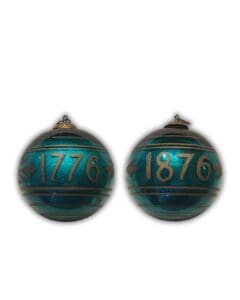
The only Christmas tree ornament in the collection owned by the Glessner family was purchased by John and Frances Glessner when they attended the Centennial Exposition in Philadelphia in August 1876, hence the prominent dates of 1776 and 1876 painted on the two sides. After both of their children married in 1898, the Christmas ornaments were split between them, with this ornament passing down through four generations of son George’s family.
Kugel is the correct term for this type of heavy glass Christmas ornament made in Germany, usually lined with silver, and featuring an embossed brass cap for hanging. First produced in the late 1840s, these heavy glass ornaments (not to be confused with the later thin-walled glass ornaments produced after 1900) were relatively unknown in the U.S. at the time of the 1876 Exposition. As such, this ornament would have been quite a novelty when the Glessners acquired it and brought it home to their son George, who would have been just five years old when it was first hung on the family Christmas tree.
The Centennial Exposition, held in Philadelphia’s Fairmont Park from May 10 to November 10, 1876, was the first official World’s Fair in the United States, and was held to commemorate the 100th anniversary of the signing of the Declaration of Independence in Philadelphia. An estimated ten million people attended the fair, visiting the 200 buildings and exhibits from 37 countries. The Main Exhibition Building, measuring 464 by 1880 feet, was the largest building in the world at the time. The Glessners spent two days at the Fair, viewing everything from the right arm of the Statue of Liberty holding its torch, to the world’s largest knife and fork (measuring more than 10 feet in height). Today, only two buildings remain from the Fair – Memorial Hall and the Ohio House (which the Glessners would have certainly visited, both being native Ohioans.)
Bronze Face and Hands of Abraham Lincoln
Glessner House, Chicago, IL
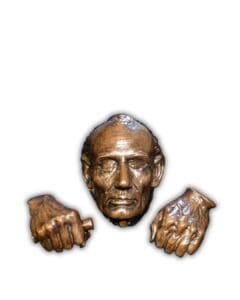 The bronze life mask and hands of Abraham Lincoln, displayed on the partners desk in the library, were among John Glessner’s most cherished objects. They are exact copies of the original plaster casts made by Chicago sculptor Leonard W. Volk. The face was made in April 1860, and the hands the following month, immediately after Lincoln’s nomination by the Republicans for the presidency. (The right hand was still swollen from all the handshaking after his nomination – a difference that is visible in the casts). Volk eventually gave the plaster casts to his son Douglas, who later passed them on to a fellow art student.
In February 1886, editor/poet Richard Watson Gilder, sculptor August Saint-Gaudens, and art collector Thomas B. Clarke sent out a letter to a select group of individuals soliciting subscriptions in order to purchase the original casts and present them to the National Museum in Washington (now the Smithsonian Institution). Subscribers who gave $50 received a replica set in plaster; those who gave $85 received a set in bronze. Frances Glessner noted in her journal that their bronze set, inscribed with John Glessner’s name on the underside of the life mask, was received in late May 1886. In 1888, the original plaster mask and hands, together with the first bronze casts, were presented to the National Museum. A total of 33 subscribers provided the funds, including John Glessner and his wife’s first cousin, the American sculptor John Quincy Adams Ward. Ward was a good friend of Saint-Gaudens, so it appears likely he suggested that John Glessner be including on the mailing list, when the original subscription letter was mailed in February 1886.
Quilt
Clarke-Ford House, Chicago, IL
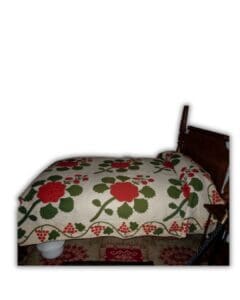
Cotton applique quilt made in nine squares. Each square contains a large blossom on stem with two small and six large leaves, with a spray of buds and four new blossoms and two sets of two new leaves. Grapevine border. Very fine quilting with double diagonal lines on border and undulating feather work and double diagonals throughout interior. The colors remain vibrant and are primarily in reds and greens, with yellow and black highlights. There is either no interior batting or it is very thin. . It measures 87 by 85½ inches.
Sampler
Clarke-Ford House, Chicago
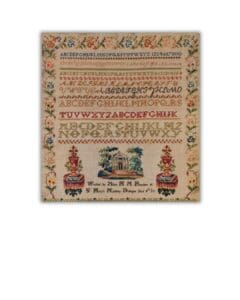
Alice Mary Beaubien completed this sampler at St. Mary’s Academy, Dubuque, Iowa, December 8, 1851 at the age of 12. St. Mary’s Academy was founded by the Sisters of Charity in 1843. They were known for their needle work. Alice was the daugher of Mark Beaubien, Jr. (1819-1860) and his second wife, Sarah Jane Wilson (b. 1820). Her father was a merchant in Chicago around 1836 and was the owner of a stock and livery business in Rock Island, Illinois, as well as a real estate and horse dealer in Dubuque. Alice was the granddaughter of Mark Beaubien (1800-1881) who was one of Chicago’s earliest settlers. The sampler is stitched with wool thread on a linen ground. It consists of 9 rows of the alphabet in different fonts separated by rows of practice stitches. Below the alphabets there is a gazebo set in a garden flanked by two altars each featuring a cross inside a chalice sitting on a Bible. It is a good example of the transition from the earlier styles of samplers to the later style of Berlin work done in the Victorian age. It encompasses a little bit of each as it bridges this time frame and illustrates the changing tastes and hobbies in America during this period. It once hung in the Church Home (for the elderly) owned by the Episcopal Diocese of Chicago. The sampler is 30⅛ by 28⅝ inches.
Pianoforte
Clarke-Ford House, Chicago
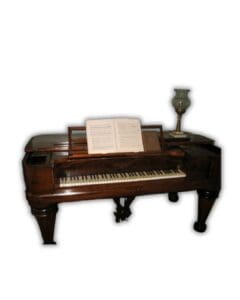
Chickering square grand pianoforte, c. 1855 (numbered 15670) with cast iron frame, rosewood veneer, spruce soundboard, oak and rock maple legs and foundation, and ivory and ebony keys. A manual dated September 1, 1853 for a very similar model was found in the wall during house renovations in the 1980s, indicating the Clarkes likely had this type of piano in their parlor. Chickering pianos with their new patented frames won the higest awards at the London Crystal Palace Exhibition in 1851. Steinway hailed Chickering as “the father of American pianoforte making.” The instrument measures 35½ inches tall, 71¾ inches long, and 34½ inches deep.
-
Indiana
Cake Pan
David Lenz House, New Harmony, IN
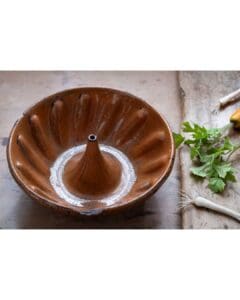
From 1815 to 1824 Harmonists operated a pottery, producing red earthenware , a ceramic made of red clay and silica. This Cake Pan, made in New Harmony around 1820, was found in the David Lenz House. It is a rare survivor of the more specialized earthenware ceramics made by the Harmonist potters.
The Cake Pan is circular with a cone shaped protrusion from the center of the base. The sides have a series of indentations on them to make a pattern and taper downward from mouth to base. The condition is good, there are two chips on the outer edge of the mouth of the pan.
-
Kentucky
Desk and Bookcase
Liberty Hall, Frankfort, KY
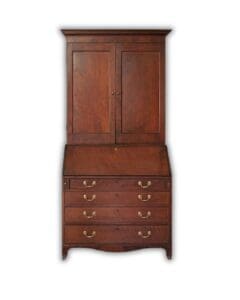 This cherry desk and bookcase is one of the finest Kentucky-made pieces in Liberty Hall’s collection. Standing at just over seven feet tall with a comfortable slant-top desk front, eight interior lockable document drawers, and a decorative dot-and-dash motif inlaid on the cornice, this piece is surviving evidence of the meticulous craftsmanship of early Kentucky cabinetmakers. Believed to have been made in Frankfort, the specific maker remains a mystery, though two interior drawers bear red pencil markings, including a set of initials that remain clues to their identity. Senator John Brown likely used this desk as his personal workstation while at Liberty Hall, penning letters to fellow compatriots like Thomas Jefferson. The upper bookcase portion may have been used to store the Brown family’s extensive collection of books on law, poetry, classical literature, and more. Whoever the maker(s) were, the Browns must have been pleased with their work–a similarly impressive cherry linen press in Liberty Hall’s first-floor bedroom is believed to have originated from the same shop.
-
Maine
Cyprian Southack, The Harbour of Casco Bay and Islands, engraving
Tate House Museum, Portland, ME
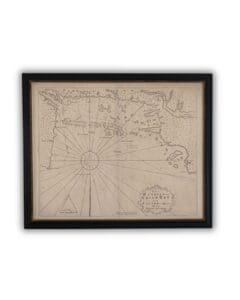
Southack was an early explorer of Casco Bay in 1698. His chart appeared in The English Pilot, The Fourth Book, from 1721 until 1794
Sophia Means, Marking Sampler
Tate House Museum, Portland, ME
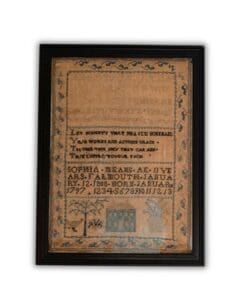
Young girls learned basic sewing through marking samplers. Living across from Tate House in the Means House, eleven-year-old Sophia created this sampler as part of her school curriculum.
Chinese export porcelain platter & teacup
Tate House Museum, Portland, ME
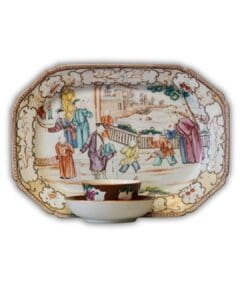
The famille rose (polychrome) and Batavia-type (brown-glazed) decorations are known to have been used at Tate House and related shards have been recovered archaeologically
Woven splint baskets
Tate House Museum, Portland, ME
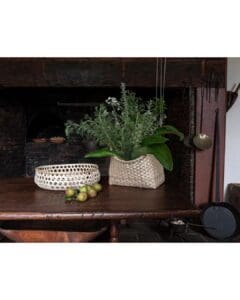
Members of the Maine Wabanaki Basket Makers Alliance, Peter Neptune and Debora Nicholas recreated historic forms. Woven splint baskets, made for millennia by the Indigenous tribes in what is now Maine, were important trade items. References to “Indian baskets” appear in colonial probate inventories; they were convenient for collecting garden herbs and produce, and for food preparation and storage
-
Massachusetts
Horse-Drawn Town Carriage
Quincy Homestead, Quincy, MA
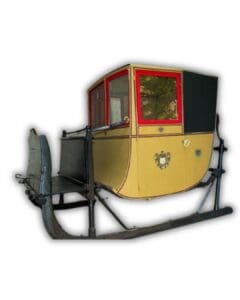
Horse-drawn Town Carriage, English, ca 1777.
Originally designed as a carriage for traveling short distances about town, the wheels were removed and the chariot was converted to a sleigh in the 19th century. This carriage was presented to American patriot John Hancock in the beginning of the American Revolution. The British ship transporting the carriage was captured by the Civil Usage, an American privateer brigantine out of Newburyport, Massachusetts. The owners of that ship presented the carriage to John Hancock. Dorothy and John are said to have used the chariot while in Philadelphia. The chariot was donated to the National Society of the Colonial Dames of Massachusetts(NSCDA-MA) in 1920 by a descendent of the Quincy family and reported the carriage had been domiciled in Maine and used by the family throughout the 19th century in sleigh form due to the long Maine winters. When it arrived, it was in disrepair and entirely black. In 2013, the NSCDA-MA launched a campaign to restore the carriage. In 2014, with generous funding provided by the City of Quincy’s Community Preservation Committee, the restoration and conservation by Blackburn Conservation of Middleboro, Massachusetts began. Their work revealed that the original color scheme and decorative designs included the rear upper section of the chariot had always been black however the rest of the chariot had been painted over. Removal of the black paint revealed the original colors and the two doors bore white shields surrounded by gilt-edged, fringed and tasseled drapery.
Wainscot Chair
Martin House Farm, Swansea, MA
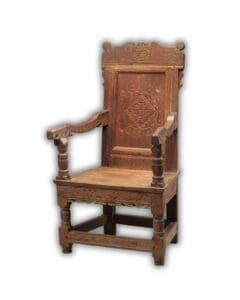
This heavy oak chair likely traveled with Hugh Cole to Swansea, Massachusetts from England. Cole was one of the first colonists to settle in Swansea; stories about the chair allege that Wampanoag sachem Metacom (known to the English colonists as King Philip) sat in the chair while visiting Cole.
Court Presentation Dress
Prescott House, Boston, MA
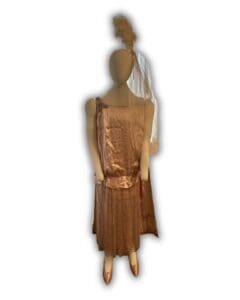
This dress, train, and hair feathers were worn for presentation to King George V and Queen Mary Teck of England. Court presentation clothing adhered to a strict policy; the type, color, and size of the feathers (ostrich; white unless in deep mourning and then black was acceptable; small) were dictated and known as the Prince of Wales Plume.
Lengths were given for veils (maximum of forty-five inches) as well as trains (two yards maximum, and should only extend eighteen inches from the heel to the end when standing). Color of the dress and gloves were up to the discretion of the wearer, with fans or bouquets being optional.
When this was made, the House of Worth was no longer at the cutting edge of fashion and would have been considered a smart and safe choice to be worn for such an occasion. Likely designed by the grandson of Charles Worth, Jean Charles, a court presentation dress sketch very similar to this one is in the collection of the Victoria & Albert Museum, London.
Dress (Dolley Madison)
Prescott House, Boston, MA
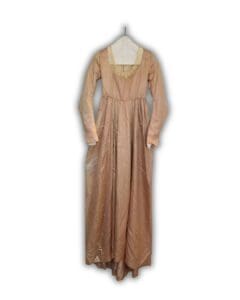
Although understated, this dress worn by first lady Dolley Madison is a prized piece not just for its connection to American history but for simply surviving. The dress dates to sometime between 1794-98, a time when fashions were rapidly changing. As bust lines changed, dresses could be partially unmade and remade to meet changing styles, and most were. For some reason, Dolley’s dress, which dates to the first few years of her marriage to James Madison, remained unchanged and was simply set aside.
Stylistically, the dress leans French rather than English, as the English preferred a fuller, rounder version of the silhouette with more coverage. While not as revealing as a traditionally French gown could be, Dolley’s addition of the handmade lace allows for the idea of a more revealing neckline while preserving her modesty and showcasing her wealth.
-
Minnesota
Decorative Box
Alexander Ramsey House , St. Paul, MN
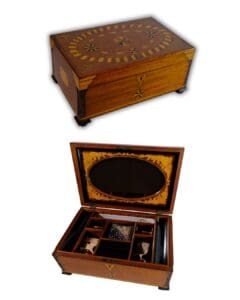
The box was presented to Alexander Ramsey in 1879 when he was appointed Secretary of War by President Hayes, and is made from timbers of the naval frigate USS Constitution. Anna Ramsey stored sewing supplies in the box. By the 1870s, the USS Constitution was the only ship remaining out of the six original naval frigates commissioned in 1797 by George Washington. It was in rough shape, owing to its decades of use. In 1875, a restoration of “Old Ironsides” (as the ship had been nicknamed during the War of 1812) was begun with the intention of displaying the ship at the centennial exposition in Philadelphia. The restoration was not completed in time, so it was decided to instead display the ship at the 1878 Exposition Universelle in Paris. In order to reach France in time, a coal-burning steam engine was added to the ship. The wood that had been removed during this alteration was used to make this box. Today, the USS Constitution can be seen in Boston harbor, the world’s oldest ship still afloat. This decorative box, meanwhile, can be seen along with over 14,000 other original artifacts at the Alexander Ramsey House in St. Paul, Minnesota.
Dollhouse
Alexander Ramsey House , St. Paul, MN
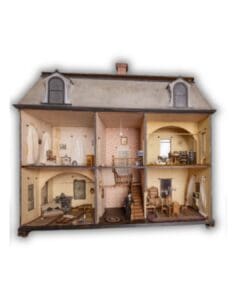
This custom dollhouse was designed to resemble a simplified version of the Ramsey House. Alexander Ramsey’s daughter Marion Ramsey Furness had this dollhouse made for her then five-year-old daughter, Laura Furness, as a Christmas present in 1887. The dollhouse was built by Matthew Taylor, the master carpenter who had worked on the Ramsey House, for a cost of $25 (equivalent to several hundred dollars today).
Steinway Style III Grand Piano
Alexander Ramsey House , St. Paul, MN
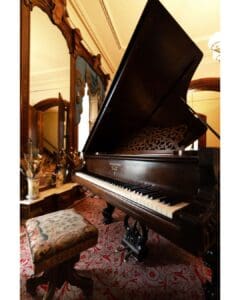
Alexander Ramsey purchased this piano for $1,400 in 1872 as a gift for his daughter Marion. Marion and her uncle Justus picked it out in Steinway & Son’s New York showroom. The piano still plays beautifully over 150 years later.
Marion was an accomplished pianist and vocalist who gave many public and private performances. In 1882, Marion Ramsey Furness and several of her music-loving friends formed a club they called “The Ladies Musicale,” which became Minnesota’s earliest non-profit recital-presenting organization. They soon re-named their organization, “The Schubert Club,” in honor of German composer Franz Schubert. Today, The Schubert Club continues to offer concerts, music education, museum exhibits, and student scholarships. It is one of the oldest existing arts organizations in the country.
-
New Hampshire
Rocking Horse
Moffatt-Ladd House, Portsmouth, NH
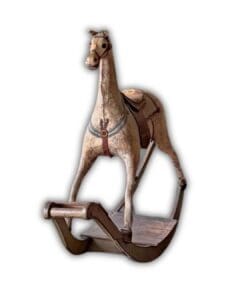
American Child’s Rocking Horse, 19th century. The horse carved and painted with hide covering. The horse, with its saddle and blanket, remains in original condition. This horse, long cherished and loved by family members now continues as a favorite among visitors young and old.
Wax profile portrait of George Washington
Moffatt-Ladd House, Portsmouth, NH
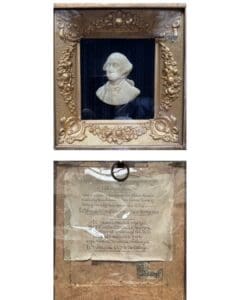
American Late 18th century/Early 19th Century wax profile portrait of George Washington originally the property of Daniel Austin. Given to the New Hampshire Society in 1916 by Mr. James Locke. The provenance and conservation history on reverse of the giltwood frame. Gift of James Locke. Photograph of reverse incl.
Portrait of Katherine Moffatt Whipple
Moffatt-Ladd House, Portsmouth, NH
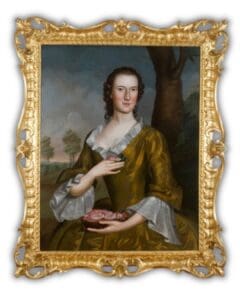
American Portrait of Katharine Moffatt Whipple (1734-1821) attributed to John Greenwood (1729-1792). The portrait painted circa 1751. Katharine Whipple was the wife of William Whipple, a signer of the Declaration of Independence. The portrait, oil on canvas, is housed in the original 18th century carved giltwood frame. Museum purchase from Ladd family descendant.
Portrait of Samuel Cutt Moffatt
Moffatt-Ladd House, Portsmouth, NH
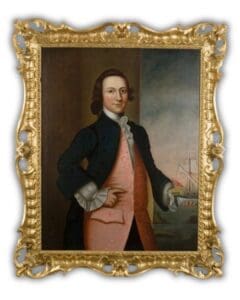
American Portrait of Samuel Cutt Moffatt (1738-1780) attributed to John Greenwood (1729-1792). The portrait painted circa 1751. The portrait, oil on canvas, housed in the original 18th century carved giltwood frame. Museum purchase from Ladd family descendant.
Kettle-Stand
Moffatt-Ladd House, Portsmouth, NH
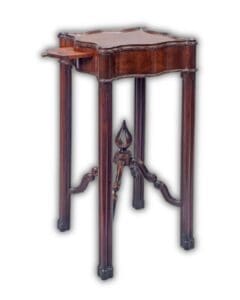
American 18th century mahogany carved serpentine kettle-stand with slide. The kettle- stand attributed to Robert Harrold of Portsmouth, New Hampshire. The stand, made circa 1765-1775, having a carved sigma curved medial cross stretcher and open flame finial. Gift of Robert J Mead.
Wallpaper
Moffatt-Ladd House, Portsmouth, NH
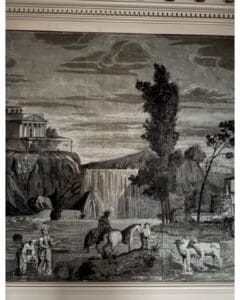
French wall paper, En grisaille, early 19th century. The paper by Dufour of Paris, France entitled Vues d’Italie. Installed in the Great Hall of the Moffatt Ladd House circa 1820 by the Ladd Family.
Foliate Relief
Moffatt-Ladd House, Portsmouth, NH
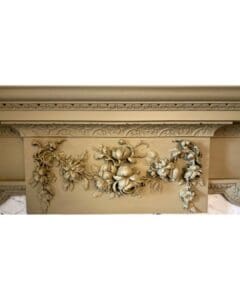
18th century foliate relief. Probably English/ Possibly American. Carved in the manner of Grinling Gibbons (1627–1729). The carving unsigned. The relief applied under mantle in Red Parlor. Original to the house, the painted floral relief likely imported from London for the Parlor.
-
New Jersey
Harvey Lewis Silver Tea Set
Peachfield, Westhampton, NJ
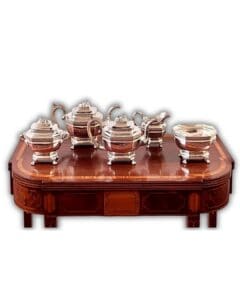
Silver tea service, marked by Harvey Lewis (w. 1811-1825). c. 1820. Philadelphia.
This neoclassical five piece silver tea set consists of two lidded teapots, one lidded sugar bowl, a creamer, and waste bowl.
The sides of the pieces bear the initials “MN” for Mary Newbold. The set bears the maker’s marks “H. Lewis,” for Harvey Lewis, est. 1811 in Philadelphia.
Mary Newbold Burr Portrait
Peachfield, Westhampton, NJ
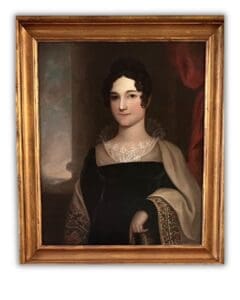
Mary Newbold married Joshua Shreve Burr in 1817. Her relation to the Burr family of Peachfield is direct, though she never resided at Peachfield. Her undated portrait hangs in the dining room at Peachfield, though it is thought to have been painted, based on the clothing and style of the portrait, around the mid-1830s, and possibly by Gilbert Stuart, though it is unverified. It is believed that she was painted to appear younger than how she would have looked when it was made.
-
North Carolina
Fireplace Decoration
Rosedale, Charlotte, NC
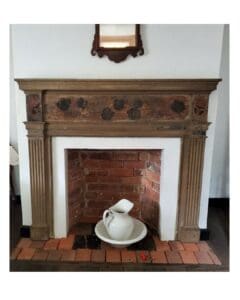
During a 1986 restoration, a handpainted grapevine and rose motif was discovered on the façade of the fireplace mantle in the girls room. It is believed to be the artwork of the girls of the Caldwell family who lived there in the mid- 19th century. We have records from Dr. David T. Caldwell’s journals showing where he paid for art tutors for the girls.
Andirons
Rosedale, Charlotte, NC
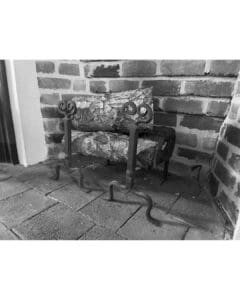
This pair of 19th century andirons are believed to be created by an enslaved blacksmith named Nat who lived and sacrificed at the Historic Rosedale Plantation. The design of the andirons reflects the Ghanian Sankofa symbol. This African concept is represented by a circular pattern which suggests that while moving forward we should retrieve things of value from our knowledge of the past. The majority of the enslaved did not participate in revolutions or insurrections, however they did engage in passive acts of resistance. The Sankofa symbol on these andirons could certainly be consider such an act, as the meaning and origin of the design would not be known to his plantation owner.
Newspaper Page
Rosedale, Charlotte, NC
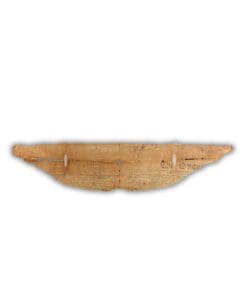
During the restoration of the fireplace in the sitting room, a torn piece of newspaper was discovered behind the wall. The newspaper scrap has an article on the back that reported on a treaty in Eastern Europe that took place in early 1815, which is how we knew to authenticate the date and by that, the date of the house.
-
Ohio
Flintlock Rifle
Kemper Log House, Cincinnati, OH
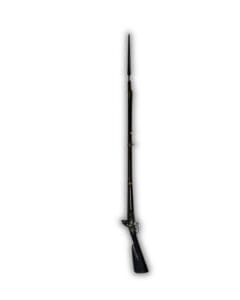
The Flintlock rifle was the first item donated to the Kemper House in 1916. Records indicate that the gun was the property of Col. John Riddle and he brought it to Cincinnati in October 1796. It was donated to the House by his great grandson, Edgar B. Riddle. The musket in the Kemper Log cabin is a French army muscat made at the royal arsenal at Charleville.
It is not the 1763, which it closely resembles, but appears to be model 1771 or 1773. On the rear end of the barrel is a proof mark, and what appears to be the number 75 or possibly 73 – this may mean that the gun was manufactured in 1775 or possibly 1773. It is undoubtedly one of the muskets sent over by the French Government or brought over by Lafayette. The ramrod is not original but is facsimile made in 1924, all other parts of the musket are original.
-
Oregon
Rocking Chair
Hoover Minthorn
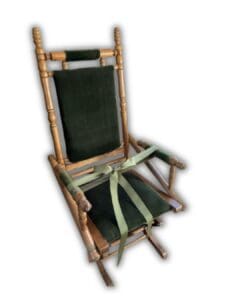
One of the first things that guests see when they enter the museum are the two rocking chairs from the mid-1800s that were owned by Dr. Henry John Minthorn. As his nephew Herbert Hoover recalled, only adults were allowed to sit in these chairs, with the parlor being off limits to children like himself. This all changed on the museum’s opening day on August 10th, 1955, when Hoover was finally able to sit in this green chair. He had only needed to become president and reach his eighties to do so!
The design of these chairs were popular when the Minthorns moved into this house. Both are called platform rocking chairs, with the concept being for the chair to rock on top of a platform which rests on four legs. This keeps the chair from moving across the ground as it’s rocked, though both chairs use different designs to achieve this effect; the green chair uses rotating mechanisms at the front and back, whereas the chair with a floral pattern uses springs located at its center. These original pieces were located by Burt Brown Barker in his preparations to make the historic home a dedicated museum in the 1950s.
Fishing Rod and Creel
Hoover Minthorn
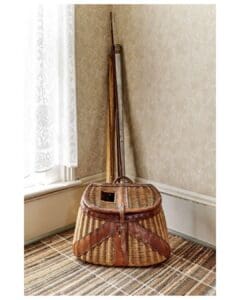
Often remembered as America’s ‘fishing president’, Herbert Hoover had a natural talent for fishing and began at an early age at his childhood home in Iowa. Though he started at West Branch’s Waposinonoc Creek, some of Hoover’s fondest memories of Oregon relate to fishing and the outdoors; in his memoirs, he wrote that “there was not so much water in proportion to the fish then, and legal limits had not been thought of.” With the help of his uncle and a friend, he was able to catch as many as a hundred trout in one afternoon, such were the times he lived in. The fishing rod and creel on display were donations from Hoover’s great-grandchildren from after the museum’s opening in 1955. The rod is composed of bamboo, a cork handle and metal rings for the line, and would likely have had a Pflueger-made reel. Consisting of three parts, it would have been disassembled and placed inside a metal container for transport. It is unknown exactly what time period the rod and creel come from due to the lack of manufacturer’s marks and pre-1955 provenance.
Replica Mourning Quilt
Hoover Minthorn
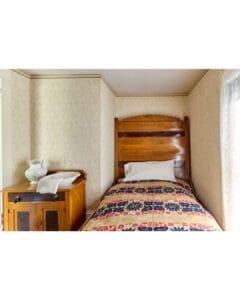
Victorian high society had several symbolic languages in order to communicate while following rigid social conventions, some of which spread in influence to various regions and social classes. For example, desires could be communicated via colors and types of flowers, feelings could be shown via fan and hand gestures, and quilts were often used in this symbolic language as well. One common quilt type was a mourning quilt, used to signify a death in one’s life, and as a form of condolences for the one who was mourning. The quilt pictured here is a replica of the mourning quilt that was gifted to young Herbert Hoover after his arrival in Oregon in 1885.
Hoover’s parents had both passed away by the time he was only 9 years old, and he joined the Minthorn family under these tragic circumstances. A family member made a mourning quilt for him as a comfort, a gesture of goodwill, and, assumedly, a way to honor his parents’ memory. The replica quilt is kept in Hoover’s childhood bedroom, with his original bedroom furniture, which is also pictured.
Rooster Napkin Ring
Hoover Minthorn
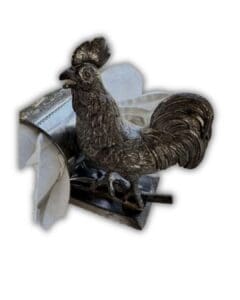
This napkin ring originally belonged to Tennessee Minthorn, the oldest Minthorn child and the cousin of Herbert Hoover. It was made by the Meriden Britannia Company, formed in the 1850s in Connecticut. The napkin ring design is very unique, potentially custom-made. It features a crowing rooster as well as engravings of vines and Tennessee’s name. As this was common during the 1800s, it was likely a christening or birthday gift.
Given that the Minthorns were a very religious Quaker family, it is possible that the rooster holds religious symbolism, specifically in reference to the rooster crowing in Matthew 26:75. Unfortunately, Tennessee Minthorn passed away at only 17 years old, shortly after Hoover arrived at the Minthorn home, due to a respiratory illness.
-
Pennsylvania
Whole Cloth Quilt
Stenton, Philadelphia, PA
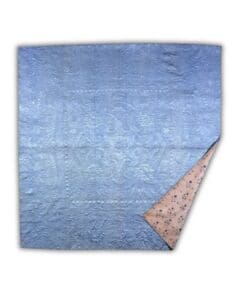
This blue silk faced quilt is a textile treasure for its connection to the Logan family of Stenton. Polly Norris, an intellectual in her own right, was James Logan’s granddaughter and wife of John Dickinson, known as the “Penman of the Revolution.” Eighteenth-century quilts are almost exclusively whole-cloth quilts, meaning that multiple widths of a single textile comprise the quilt face, with a pattern applied through quilting on designs in a running stitch. Silk was an especially fine choice for facing fabric, lending a shine and luminosity to this quilt. A number of Philadelphia area Quaker women owned quilts and petticoats, such as this one, that feature common design motifs associated with the Marsh School, indicating a shared teacher/pattern drawer or design influence. The double-handled urn with flowers seen in the centers of the border of the quilt is a signature of the Marsh School’s needlework and quilting designs. The printed cotton backing fabric of this quilt has long been emblematic of Stenton’s collections and was reproduced by Brunschwig and Fils in the 1970s as both fabric and wallpaper.
Shellwork Shadowbox Grotto
Stenton, Philadelphia, PA
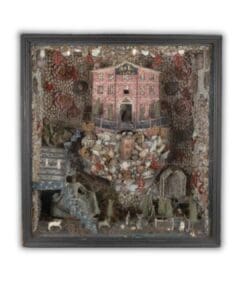
Crafted by Anne Emlen, sister-in-law to Hannah Emlen Logan (1722-1777), this grotto box was bequeathed to Stenton by Samuel Logan Betton (1842-1915). The grotto belongs to a group of shellwork boxes made by mostly Quaker women in Philadelphia and the Delaware Valley during the mid-eighteenth century. Shellwork was often taught to young women alongside needlework and other “accomplishments” and advertisements for Philadelphia shellwork teachers can be found throughout the mid and late eighteenth century. A double-handled urn and flower design, often associated with Philadelphia needlework, is rendered in shells on the side walls of the box. The shells used to make the grotto hail from the Caribbean basin (as far north as Charleston), brought to North America’s ports along the same shipping routes that ferried triangle trade commodities, such as sugar, rum, exotic woods, and enslaved Africans. Emlen’s grotto is unique among its comparable examples for her inclusion of a large tent olive shell perched on the cliff at the center of the composition. The tent olive mollusk is native to the Pacific Ocean off the coast of South America and was likely harvested in modern-day Panama. Anne’s grotto is both hyper-local and highly global in its design and materials, representing connections to networks of goods, people, and ideas that span oceans and continents. https://decorativeartstrust.org/stenton-grotto-article/
Slip-Decorated Presentation Basin
Stenton, Philadelphia, PA
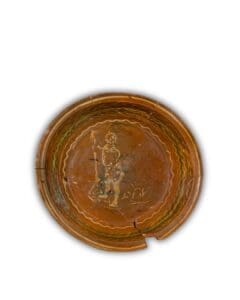
This thrown, slip-decorated, redware basin is known at Stenton as the “Indian Bowl” because the human being depicted here in a slipped clay sketch is Sa Ga Yeath Qua Pieth Tow, “King” of the Maquas, a member of the Haudenosaunee Mohawk people of the Iroquois Confederacy. He was part of a delegation of four so-called “Indian Kings” who traveled from Boston to London to pledge allegiance to Queen Anne in 1710. John Verelst painted full-length portraits of the four men, who were feted about London, after which John Simon created mezzotint engravings. Sets of these prints were widely disseminated in the colonies, and while not documented, it is quite likely that in his role as Provincial Councilor James Logan received or acquired an unframed set, one of four that were sent to Pennsylvania. Each of the Five Haudenosaunee nations also received prints, suggesting that these images came to hold meaning in both Anglo and Native colonial spaces. We can speculate that perhaps James Logan commissioned this bowl to play a ceremonial role in gatherings of Indians at Stenton prior to treaty meetings in Philadelphia. The portrait bowl may have symbolized the Anglo-Iroquoian alliance and would have served as a visual reminder of that 1710 relationship pledge and assurance of military protection for Pennsylvania from the French. The lack of wear on the bowl and the image itself suggest a display, presentation, or ceremonial function, perhaps for washing of hands or feet during a Woods Edge or Cleansing Ceremony. https://chipstone.org/article.php/427/Ceramics-in-America-2008/Indian-at-Stenton:-A-Trail-Left-in-Slip-on-a-Redware-Bowl
High Chest
Stenton, Philadelphia, PA
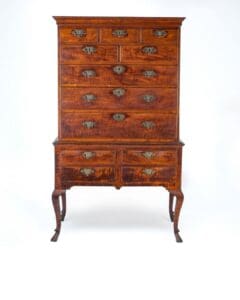
This high chest and its mated dressing table are almost certainly the “maple chest and table” listed on James Logan’s probate inventory in the Stenton Yellow Lodging Room in 1752. Furniture scholar Philip Zimmerman dated the pair to 1738 because on November first of that year, James Logan acquired nineteen brass handles and escutcheons, the precise number that fits this chest and table, which is somewhat distinctive for the four drawer arrangement (without escutcheon plates) in the lower cases of the chest and in the table. Stenton’s Yellow Lodging Room was an ensuite honey-colored interior featuring a suite of twelve honey-colored maple side chairs and this high chest and table, along with ochre paint and old fustic worsted damask bed furniture and window curtains.
Colonial Dame Pamela Cunningham Copeland (1906-2001) bequeathed this striped maple high chest and its mated chamber table to Stenton in 2001. The pair had descended to Robert Restalrig Logan (1874-1956), who sold them to the antiques dealer Joe Kindig, Jr. (1898-1971), who in turn sold them to the Copelands for their maple bedroom at Mt. Cuba in Delaware.
Bookcase
Stenton, Philadelphia, PA
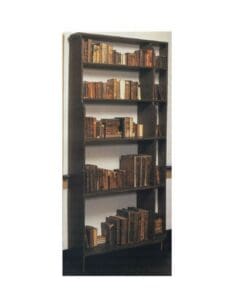
This simple bookcase of local hard pine, probably built on the Stenton plantation when the need for more shelving arose, speaks to James Logan as erudite scholar and obsessed book collector. Found in the 1950s in Stenton’s middle garret room, now believed to be a space where enslaved people slept, this bookcase was tried in various locations throughout the house before determining it was made to sit on the partition wall between the Yellow and Blue Lodging Rooms on Stenton’s second floor. Without the support of the wall, this bookcase is rickety. Cut-outs at the rear sides allow the chair rail and baseboard to key into the bookcase providing its support. Perhaps because of the awkward curved shelves at the right that accommodate a secondary door swing into the Blue Lodging Room from the landing, this bookcase did not leave the house with the books. The shelves left an oxidation ghost on the board wall in the middle garret, where the bookcase stood for about two hundred years, after James Logan’s death and the departure of his nearly 3000-volume library to a new Loganian Library building on Sixth Street opposite the State House square. Remarkably, the library remains intact today in the collection at the Library Company of Philadelphia. The bookcase represents a worldly, scholarly collection assembled by a man who could read seven languages and enjoyed math, science and the writings of classical thinkers. And then that same bookcase likely became furniture for enslaved people sleeping in the Stenton’s Middle Garret from the 1750s onward. That a shelf would be needed in that unheated space suggests that by the second generation the enslaved had acquired sufficient personal possessions requiring a place to store them. The wrought iron hook on the right side of the bookcase corresponds to several identical ones in the board wall in the garret. These could have in part served to tie down the rickety shelf and to hang clothes.
-
Tennessee
Mary’s Dresser and Cheval Mirror
Travellers Rest, Nashville, TN
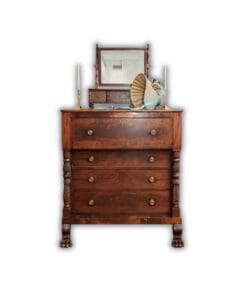 A mahogany and veneer dressing glass or shaving stand, having a pivoting oblong molded top with three short drawers flanked by turned split columns all resting on paw feet.
27.5″ H x 27″W x 9.5″ D; a mahogany, cherry, and mahogany veneer over poplar classical-style, originally at TR, deep top drawerwith lower drawers, pineapple pilasters, sides are cherry, claw feet and turned in rear, reproduction pulls and castors installed in 1983, 49″ H x 43″ W x 22″ D
Portrait of George Washington
Blount Mansion, Knoxville, TN
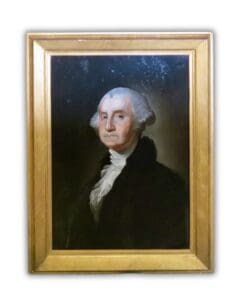
President George Washington appointed William Blount Governor of the Territory South of the River Ohio in 1790. Washington was a famous man in his own time, and when he died in 1799, images of him became very popular. Capt. John E. Sword bought a portrait of Washington from artist Gilbert Stuart (he made many copies), took it to China on his next trading voyage in 1801, and ordered about 100 copies to be painted on glass. An unnamed Chinese artist in Canton (now Guangzhou) painted this one, in reverse, on the back of a mirror. Stuart filed an injunction against Sword in 1802 in Philadelphia, but the glass portraits had already been sold. Blount Mansion Association purchased this one in 1960.